There’s a specific kind of finance stress that doesn’t show up in monthly reports: The moment an invoice gets disputed, and everyone starts playing “document hide-and-seek”.
The customer asks for proof. The team checks inboxes. Someone has the PO but not the delivery note. The site has photos, but not a sign-off.
And suddenly, an invoice that should have taken two minutes to approve turns into a week of chasing.
It’s not because people are careless. It’s because evidence is often scattered across tools, threads, and personal folders.
Here’s the practical truth we see again and again: you don’t win invoice disputes with longer emails. You win them with faster evidence.
In this blog, you’ll get a simple Invoice Dispute Evidence Pack (what to include, what to skip), plus a repeatable routine your team can run every time a dispute lands.

What good evidence gives you
When your invoice dispute evidence is organised and complete, you get:
- Speed: Fewer back-and-forth messages and “can you resend that?” loops
- Clarity: The dispute becomes specific (one line item, one mismatch)
- Confidence: Fewer “we think” conversations, more “here’s the record”
- Consistency: Disputes get handled the same way, no matter who is on leave
- Faster payment: Approvals often stall when the invoice doesn’t match the supporting documents (PO, contract, receipt)
CMS Desk takeaway: Disputes don’t drag on because they’re complex. They drag on because the evidence trail is slow.
The Golden Rule: If it’s not linked, it doesn’t exist (during a dispute)
In a dispute, nobody cares that the evidence exists “somewhere”.
They care that it’s attached, readable, and clearly connected to:
- What was agreed (contract / quote / PO)
- What was delivered (POD / GRN / sign-off)
- What was invoiced (invoice line items)
So the goal is simple: Build one pack that tells the full story, without detective work.
The Invoice Dispute Evidence Pack (what to include every time)
Think of this as your “proof bundle”. Create it once, then reuse the structure.
1) The agreement (contract/terms/scope)
Include
- Contract or SOW
- Payment terms
- Acceptance criteria (what “done” means)
Why it matters: Disputes often start as scope confusion, then show up as invoice pushback.
2) The Price Trail (quote/rate card/variations)
Include
- Accepted quote/estimate
- Rate card (if time and materials)
- Approvals for changes or extras
3) The Authorisation (purchase order + approvals)
Include
- PO document
- PO number shown on the invoice
- Written approvals if a PO wasn’t required
4) Proof of Delivery or Proof of Service (POD / GRN / sign-off)
Include (goods)
- Delivery note / POD (ideally signed)
- GRN / receiving report
- Tracking confirmation (if relevant)
Include (services)
- Timesheets/work logs
- Completion sign-off (email is fine if clear)
- Milestone approvals
5) The Invoice (clean, line-item detail)
Include
- The invoice being disputed (and any revised version)
- Clear line items that map to the PO / delivery/contract
- VAT/tax breakdown (as needed)
6) The Communications Timeline (one page)
Include
- Key dates: order raised, delivery date, sign-off, invoice date, dispute date
- Links to the emails/messages that confirm changes or acceptance
Rule: If someone can’t understand the dispute in 60 seconds, the pack isn’t finished.
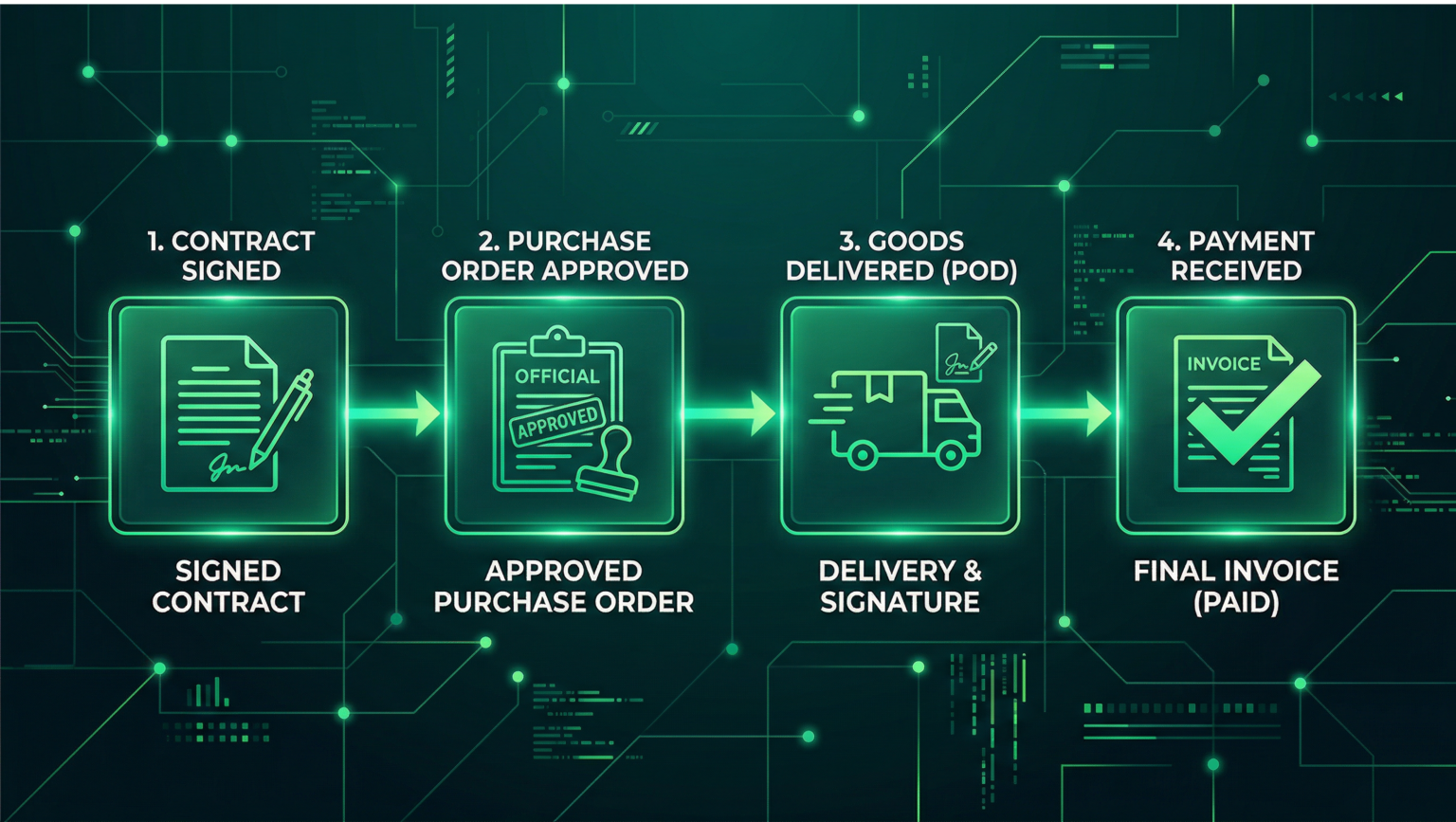
Resource: A simple “if this, then that” flow for invoice disputes
Start with one question:
What type of dispute is it?
Pick one: Price | Quantity | No PO / not authorised | Not delivered / not accepted | Out of scope / variation | Duplicate / already paid | Tax/VAT detail
Then follow the branch below.
If it’s “No PO” or “Not authorised”
Check
- Is there a PO? If yes, does the invoice reference it correctly?
- If there’s no PO, do you have written approval from an authorised person?
Send
- PO + approval trail (email/message) + invoice line mapping
Next action
- If authorised: request release for approval/payment
- If not authorised: pause and request a PO or written approval before resubmitting
If it’s “Not delivered / not received / not accepted”
Check
- Do you have POD/GRN (goods) or completion sign-off (services)?
- Is it partial delivery or a split milestone?
Send
- POD/GRN or sign-off + dates + supporting logs/photos if relevant
Next action
- If evidence confirms delivery/acceptance: request release for approval/payment
- If evidence is missing: ask for the customer’s receiving record and agree the fix (replacement/credit/revised invoice)
If it’s “Price mismatch”
Check
- Does the price match the quote/contract/rate card?
- Was any discount or variation approved in writing?
Send
- Contract/SOW + accepted quote/rate card + approvals for any changes
Next action
- If correct: point to the exact clause/quote line and request approval
- If wrong: issue a corrected invoice quickly and close the loop
If it’s “Quantity mismatch”
Check
- Compare PO quantity vs receipt (GRN/POD) vs invoice quantity
Send
- PO line items + GRN/POD + delivery notes (especially where split deliveries happened)
Next action
- If received less: issue a credit or replacement
- If evidence shows full receipt: provide receipt evidence and request approval
If it’s “Out of scope / variation”
Check
- Was the extra work requested and approved (in writing)?
- Can you map the extra to dates, logs, and outcomes?
Send
- Change request + approval + work logs/timesheets + acceptance evidence
Next action
- If approved: map evidence to the invoice line and request approval
- If not approved: agree the remedy (credit/revised invoice) and tighten change control
If it’s “Duplicate / already paid”
Check
- Has payment been made (remittance / reference)?
- Are multiple invoice versions floating around?
Send
- Remittance advice + payment reference (and note which invoice is valid)
Next action
- If paid: confirm closure and update records
- If duplicated: credit/cancel the duplicate and keep one invoice live
Shortcut: If you use PO-based purchasing, run a three-way match: PO + receipt (GRN/POD) + invoice.
It quickly shows whether the issue is price, quantity, authorisation, or missing receipt.

The fast resolution routine (20–30 minutes)
Run this as soon as a dispute arrives. Same steps, every time.
Step 1: Categorise the dispute (5 minutes)
Goal: Stop vague disputes from becoming endless.
Bucket it into one reason: price mismatch, quantity mismatch, missing PO/not authorised, not delivered/not accepted, duplicate risk.
Output: One sentence like:
“Dispute is a PO mismatch: Invoice line 2 price differs from quote dated 12 Jan.”
Step 2: Build the Evidence Pack (10–15 minutes)
Goal: One shareable bundle.
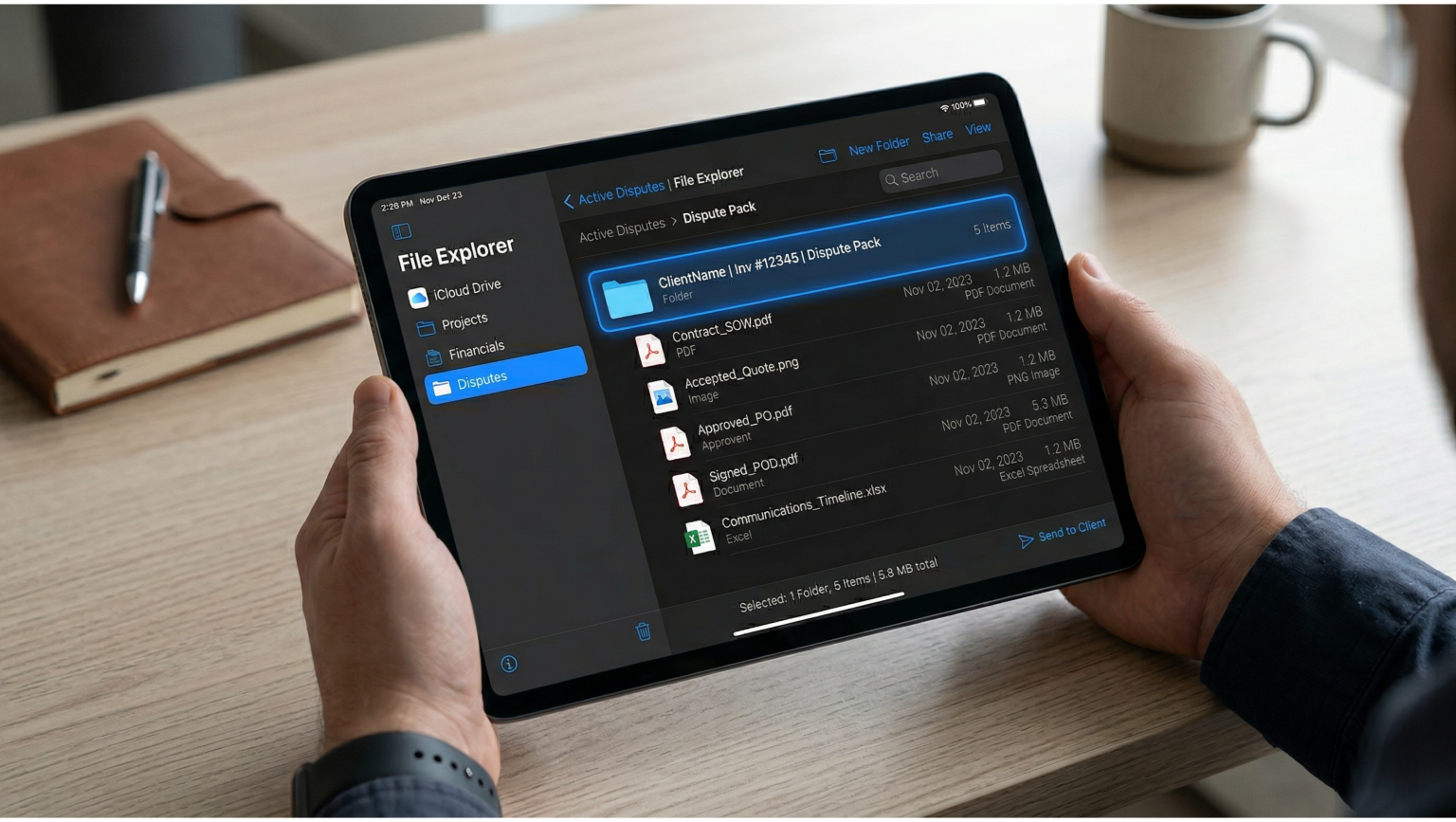
Create one folder/PDF pack titled:
Customer | Invoice # | Dispute Pack | YYYY-MM-DD
Output: Contract + PO + POD/GRN + variations + invoice + timeline.
Step 3: Isolate the gap (5 minutes)
Goal: Identify exactly what doesn’t align.
Output: Matched (payable) / mismatch (price/qty) / missing receipt / missing authorisation.
Step 4: Respond with evidence + next action (5 minutes)
Goal: Move from debate to decision.
Include:
- What they’re disputing
- The evidence attached
- What you need them to do next (approve/confirm / provide missing info)
- A clear deadline
Micro-promise: When replies consistently include a complete pack, disputes stop being “open-ended” and start closing.
How CMS Desk supports this (without adding admin)
Invoice disputes get painful when the evidence trail is split across too many places: PO in one system, delivery photos on someone’s phone, sign-off in email, invoice in finance software.
At CMS Desk, we see the best results when teams connect the workflow end-to-end, so disputes can be resolved with linked records, not memory.
If you want invoice disputes to close faster, look for a setup that helps you:
- Capture approvals with a clear audit trail
- Enforce PO discipline (and reduce “no PO” invoices)
- Attach proof of delivery/GRN or service sign-off to the order
- Match invoices to PO + receipt before payment
- Keep the full evidence trail searchable when disputes happen
Because the goal is simple: make evidence boring and easy, so payment can be fast.
Copy/paste template: Invoice Dispute Evidence Pack
Use this block internally (or as a standard checklist on every disputed invoice).
Dispute snapshot
- Customer/Supplier:
- Invoice #:
- Invoice date / due date:
- Dispute raised on:
- Dispute type (pick one): Price | Quantity | No PO | Not delivered | Variation | Duplicate | Other
- Disputed line item(s):
- Undisputed amount (if any):
- Proposed resolution: Pay in full | Pay undisputed now | Credit | Revised invoice | Other
Evidence links
- Agreement & scope: contract/SOW + terms + acceptance
- Pricing: quote/rate card + discount/variation approvals
- Authorisation: PO + approval trail
- Delivery/service proof: POD/GRN OR sign-off + logs/photos
- Invoice: current version + mapping notes
- Timeline: key dates + comms links
One-sentence summary
“Dispute is ________ because ________. Evidence is attached above.”

Copy/paste template: Evidence-first dispute reply
Subject: Invoice [####] | Evidence pack attached | Next step
Hi [Name],
Thanks for raising the query on invoice [####].
What you’re disputing (as we understand it):
- [one line]
Evidence pack attached/linked:
- Agreement & pricing: [link]
- PO/authorisation: [link]
- Delivery/service proof: [link]
- Variations (if applicable): [link]
- Timeline summary: [link]
Proposed resolution:
- Option A: Approve payment for £[amount] by [date]
- Option B: Pay the undisputed amount £[amount] now, while we resolve £[amount]
If there’s a specific document you believe conflicts with the above, reply with the line item and which document it conflicts with, and we’ll address that directly.
Thanks,
[Your name]
Conclusion: Make disputes shorter by making evidence easier
Invoice disputes aren’t inevitable, but they are predictable.
Most come down to the same thing: someone can’t quickly see what was agreed, what was delivered, and what was invoiced.
When you build an Evidence Pack habit (and use the conditional flow above), you stop disputes becoming long email threads and start turning them into quick, document-based decisions.
Less chasing. Fewer delays. More paid invoices.
FAQs
1) What documents do I need to resolve an invoice dispute?
Typically: the invoice, contract/quote, PO/approval, proof of delivery or service sign-off, and key correspondence.
2) What is three-way matching in accounts payable?
It checks the PO, the receipt (GRN/POD), and the invoice align before payment.
3) What’s the quickest way to reduce invoice disputes?
Require clear authorisation (PO/approval) and capture delivery/service confirmation consistently.
4) How do we stop disputes turning into long email threads?
Reply once with a complete evidence pack, a one-page timeline, and one clear next action with a date.